
Description
WS is an innovative suite of programs for weak-signal digital communication in amateur radio by Uwe Risse DG2YCB et al., formerly known as WSJT-X Improved.
WS grew out of WSJT-X by Joe Taylor K1JT, Steve Franke K9AN, Bill Somerville G4WJS, Uwe Risse DG2YCB and others (https://sourceforge.net/projects/wsjt/).
The WS Suite consists of three programs: WS (the main program), WS-MAP (wideband Q65 monitor) and EME65 (wideband JT65/Q65 for EME). The WS main program supports FT8, FT4, FT2, JT4, JT9, JT65, Q65, FST4, MSK144, WSPR, FST4W, and Echo.
Notes: The WS Suite is licensed under GNU General Public License, GPLv3. I am not aware of any adverse effects. However, use it at your own risk!
► For more information, check out the WS User Guide or my YouTube channel ◄
Three GUI variants
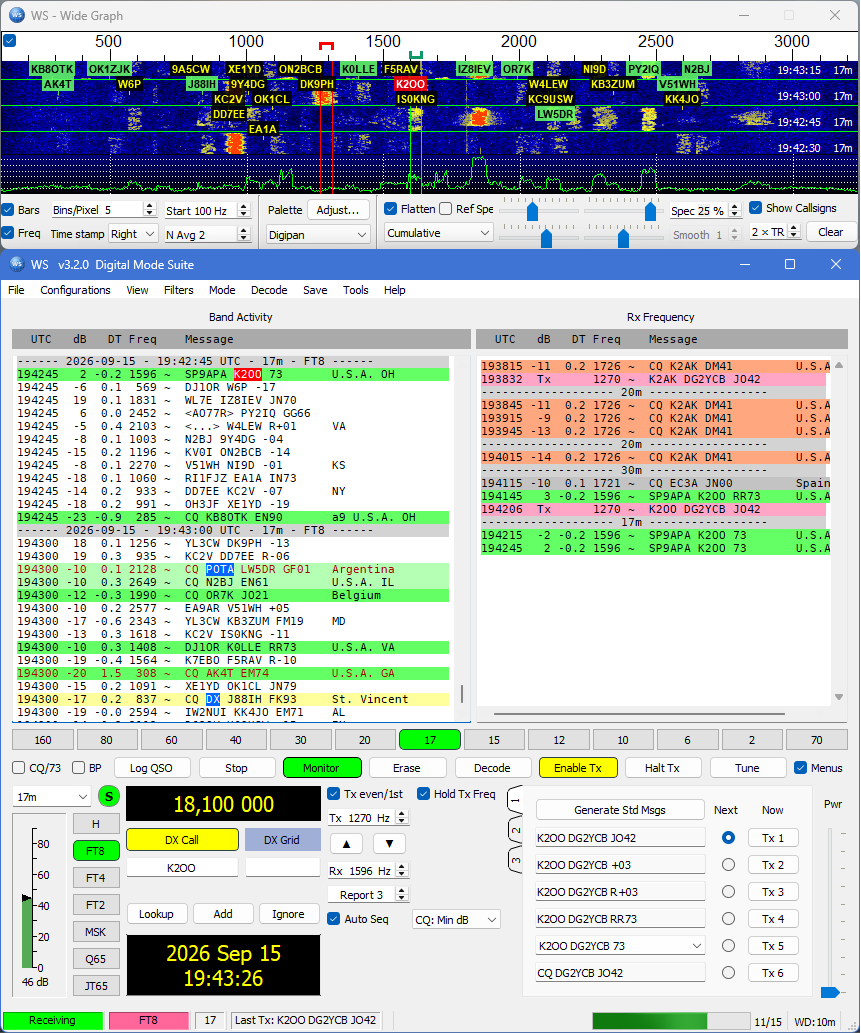
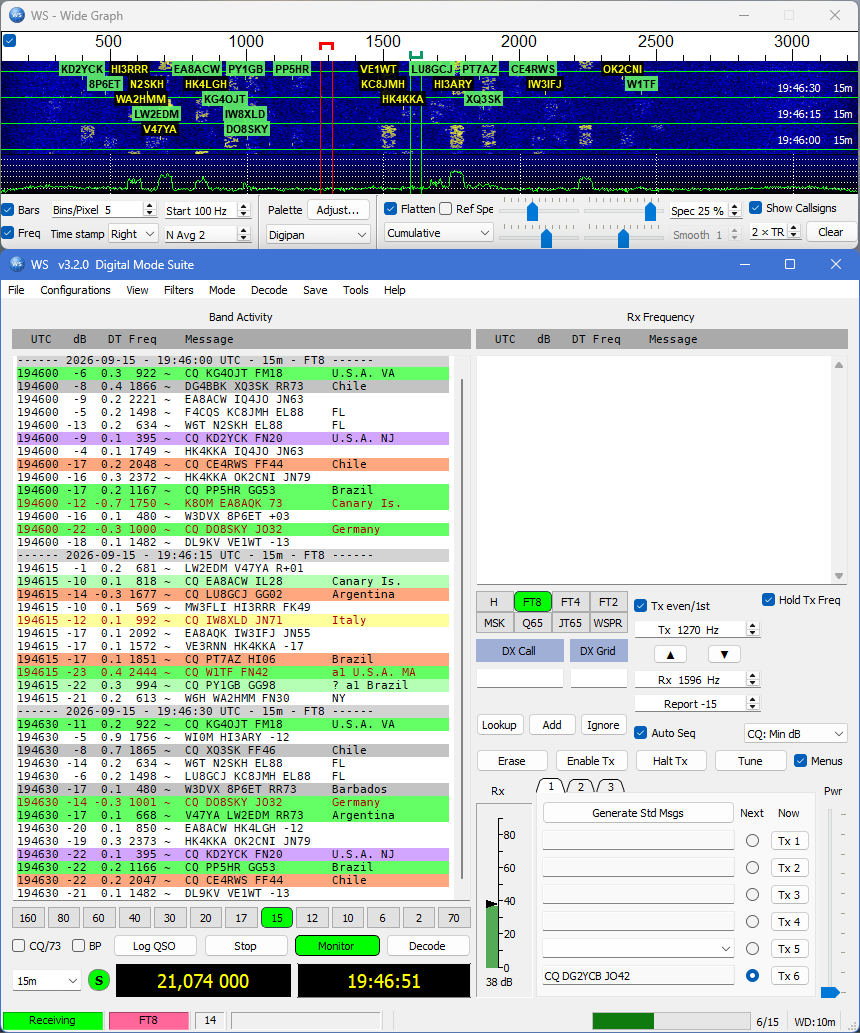
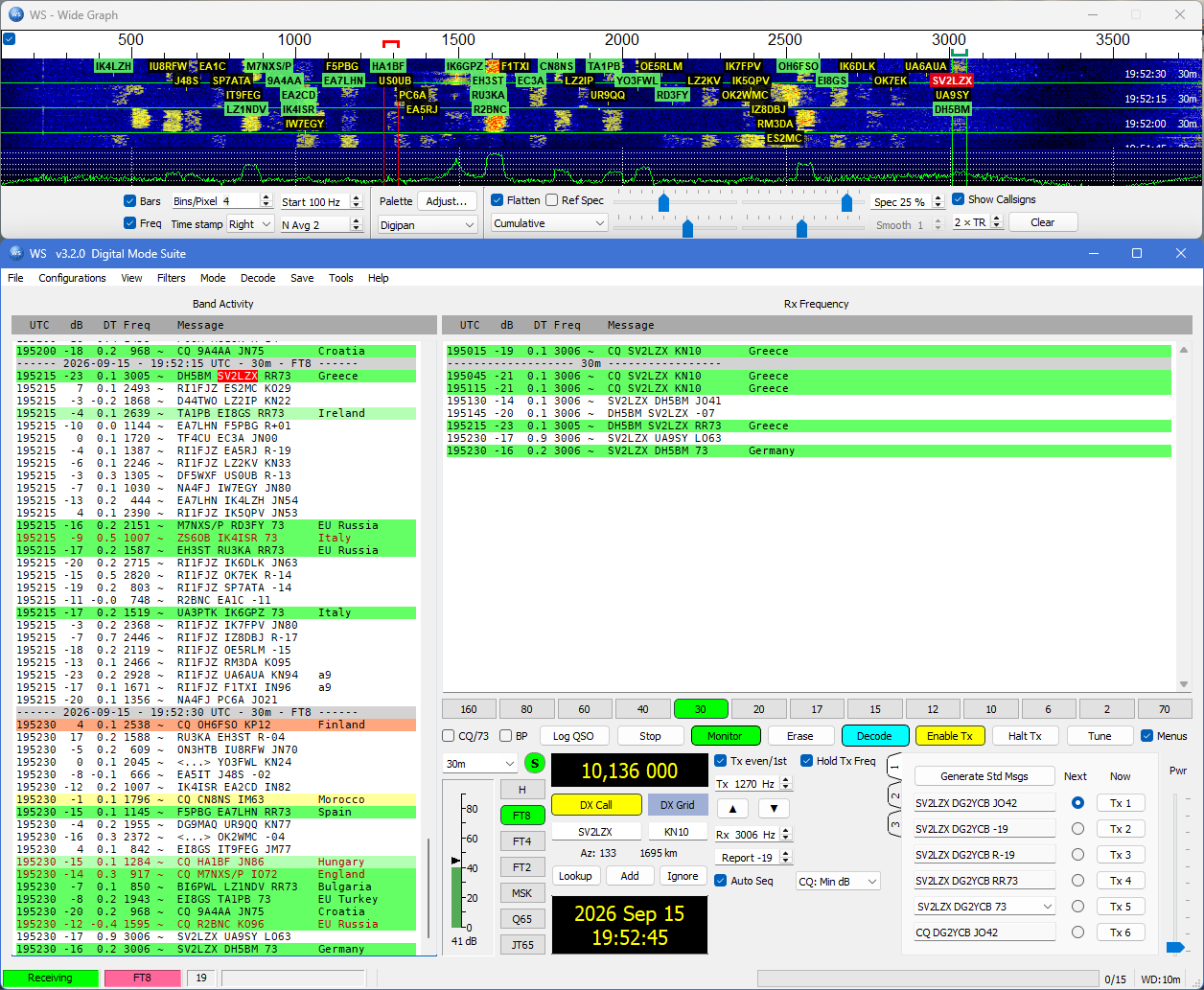
WS is available in three different GUI variants. They share the same functions, menus and settings; only the arrangement of the main window differs. Each variant has its own installer.
- WS (standard) has the familiar WSJT-X layout. This is the default download.
- WS AL (alternative layout) offers a more compact window with a larger Band Activity pane, so you scroll less.
- WS Widescreen is suitable for wide monitors: the controls move to the side and the decode panes get the full height.
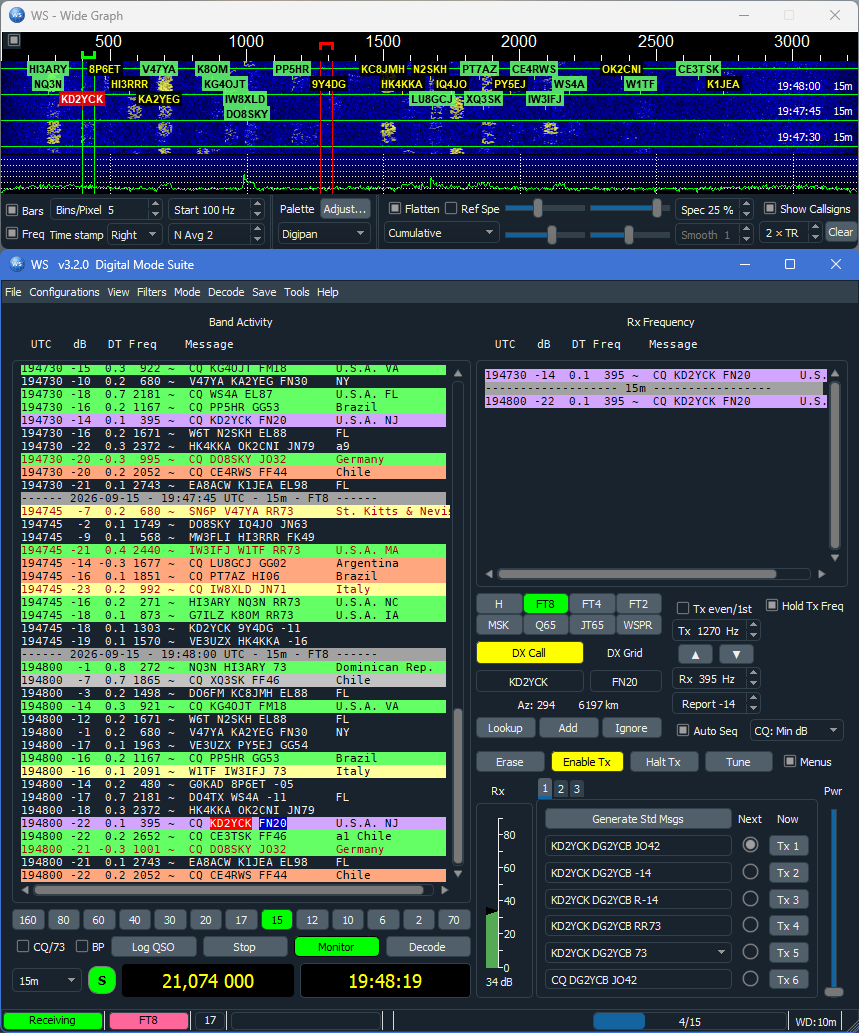
Dark Style is available for all variants and can be turned on and off from the main program window.
Download
► You can download the various versions from the WS Download Page ◄
There are installation packages for various operating systems available:
- Windows (both 64-bit and 32-bit). The installers support Windows 7 through 11 and have the .exe extension.
- Linux (.deb or .rpm).
- macOS There are Darwin packages for Intel CPUs (.dmg) as well as packages for Apple Silicon CPUs (.zip).
- Raspberry Pi Various packages for Trixie, Bookworm and Bullseye are available.
Read the Release Notes to view the version history.
User Guide
The WS User Guide is available in 12 languages:
Support
The best source of help is the wsjt-x-improved-community mailing list. You will find this to be an active forum for communication among users of WS. The chances are good that someone with similar interests and equipment has already solved your problem and will be happy to help. To post messages there you will need to subscribe.
Troubleshooting
If anything is not working as expected, first check your hardware as well as your software settings. This includes:
- Read the WS User Guide carefully. All menu items and settings are explained there in a concise and clear manner.
- You may also find the WSJT-X User Guide helpful. Most of what is described there is also valid for the WS Suite.
- Ensure you have a stable connection to your rig (USB cables, audio cables, possible RFI).
- Check if the settings at File | Settings | Radio are correct (Rig, Serial Port, Baud Rate, PTT Method, and so on).
- Don't forget to enable Split Operation. The preferred method is Fake it.
In some rare cases, the Hamlib rig driver may not properly work with your rig. Try to select a similar rig model and see if it works better, or use OmniRig instead. OmniRig has its own rig drivers, however, it is only available on Windows.
The following pdf documents provide more information on what to do if a rig control error occurs:
Windows users can easily update the Hamlib rig drivers themselves.
The WS main program has a built-in Update Hamlib feature. You'll find it at File | Settings | Radio. Before downloading a new Hamlib file, the previously used one is backed up so that it can be restored using Revert Update if necessary.
However, you can do this also manually. The entire hamlib library is in a single libhamlib-4.dll file, which is located in the bin folder of your installation (usually c:\WS\VERSION\bin\libhamlib-4.dll). It's worth a try to replace this file by the latest Hamlib Git daily snapshot (rename the old file so that you have a backup):
In some cases it may also be useful to try an older Hamlib file from this page.
Recommended Audio Settings
It is very important to avoid audio harmonics and distorted audio signals. This is usually achieved by the following step-by-step approach:
- IMPORTANT: Select 'Fake it' in the Settings/Radio menu as your 'Split mode'. If your rig does not support this, select 'Rig'. But really try to avoid 'None'! This prevents harmonics, and you have approximately the same output power over the entire audio spectrum.
- Set the transmission power of your transceiver to maximum.
- Set the Pwr slider to the minimum and click on the 'Tune' button.
- Observe the actual transmission power of your rig as well as ALC.
- Carefully increase the Pwr slider until you have reached the maximum transmit power of your transceiver.
- VERY IMPORTANT: Now reduce the Pwr slider until you reach approx. 90% of your max. Tx power. ALC should be close to zero.
- This is the maximum audio level permitted with your setup. Always stay with the Pwr slider below this max. value.
Only use the Pwr slider to reduce the transmit power. Unless driving a PA or Transverter, always keep the RF power settings of your transceiver to maximum. If you cannot properly control the Tx power with the Pwr slider, there is something wrong with the audio settings of your rig or your operating system.
If possible, check your transmission from time to time (e.g. with a webSDR) to ensure the signal is clean and not distorted.
Further information can be found in this pdf document.
Bug Reports
Bugs may be reported preferably via the wsjt-x-improved-community mailing list. To be useful, bug reports should include at least the following information:
- Program version.
- Operating system.
- Concise description of the problem.
- Exact sequence of steps required to reproduce the problem.
- In case of rig control errors, use the built-in Diagnostic Mode and send me the two files created in the process for analysis.
Copyright
WS, including its logo and all program components, is protected by copyright, and licensed under the terms of Version 3 of the GNU General Public License (GPL). Any use or modification of the code or parts thereof (e.g., the adaptation of individual program functions), is permitted only if the origin of that function or code is clearly indicated. In addition, a clearly visible reference to the original WS Suite must be included, including a hyperlink to the WS Home Page.
Please also note the WSJT-X copyright notices, as they generally apply to all software based on it as well.